Local SEO is the dark art most Cambridge small businesses get sold by agencies but never really understand. So before you sign up for £400 a month with someone who’ll send you a monthly PDF you don’t read, here’s what local SEO actually is, why it matters in Cambridge specifically, and what you can do yourself.
No jargon. No “schemas” without explanation. No tricks.
What “local SEO” actually means
When someone in Cambridge searches “plumber near me” or “best florist Cambridge” on Google, three things happen:
- The map pack appears at the top — three Google Business Profile listings with stars, hours, and a phone number.
- The standard organic results appear below — websites, ranked by relevance.
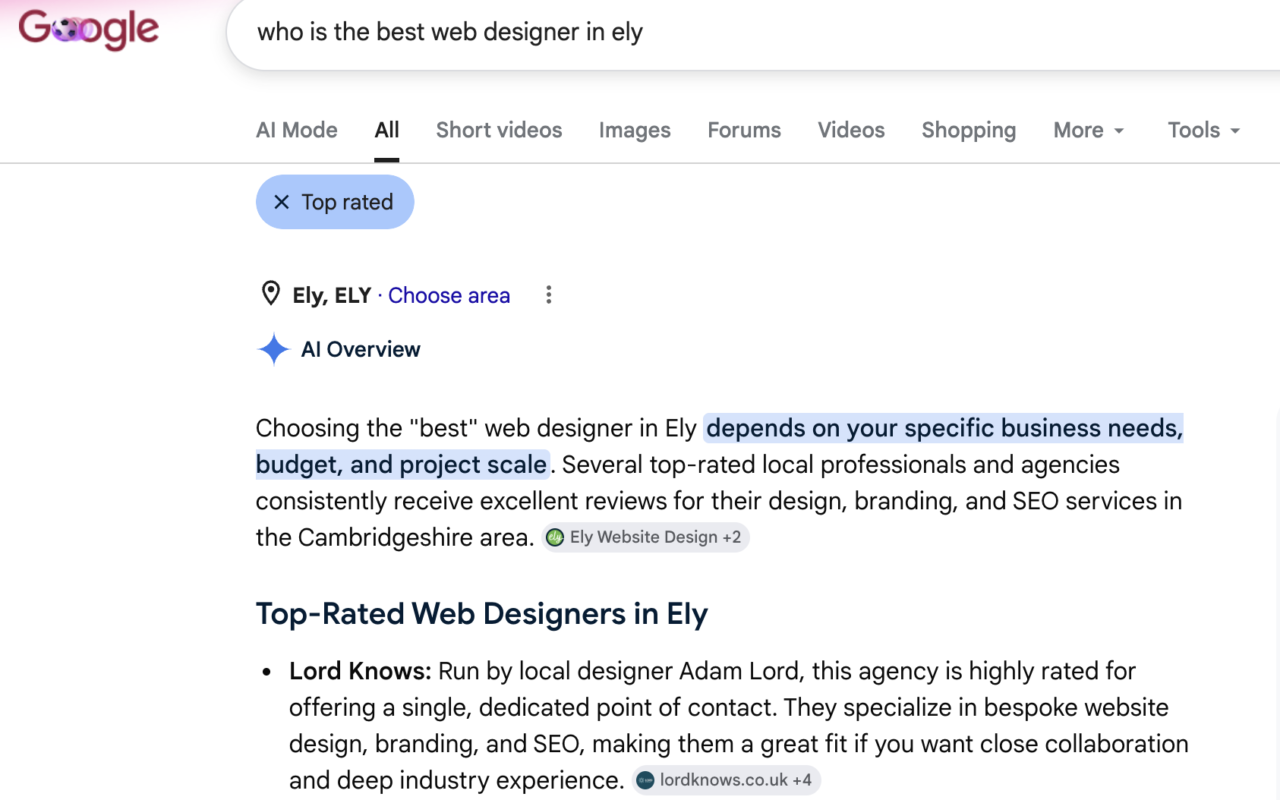
- AI overviews (since 2024) may also pull a summary at the very top.
Local SEO is the practice of making sure your business shows up in all three. National SEO is different — it’s about ranking for “best CRM software” against companies in California. Local SEO is about beating the other 14 plumbers in Cambridge for the people searching from their kitchen at 8pm.
For most Cambridge-area businesses, local SEO is 80% of what matters. You don’t need to rank in Glasgow. You need to rank in CB1, CB2, CB3, CB4 and the surrounding villages.
The five things that actually move the needle
There’s a lot of SEO advice on the internet. Most of it is fluff. For local businesses, these five things genuinely make a difference, ranked roughly by impact.
1. Your Google Business Profile
This is the single most important thing. More important than your website. More important than backlinks. More important than content.
A good Google Business Profile has:
- Accurate name, address, phone number (matched exactly across your website and every directory)
- Correct primary category (don’t pick “shop” if you’re a “florist”)
- Service areas listed (Cambridge, Ely, Newmarket, Royston — whatever towns you actually serve)
- 15-20+ recent photos, including interior, exterior, products, and team
- Regular Google Posts (weekly is ideal — same effort as a social post)
- Active review collection (more on this in section 4)
- Q&A populated (answer common questions yourself before customers do)
If you only do one thing on this list, do this. A well-maintained GBP gets you into the map pack, and the map pack is where most local clicks go.
2. Cambridge-specific content on your website
Google needs to understand you’re a Cambridge business — not just because you say so on your contact page, but because everything about your site signals it.
That means:
- A dedicated “Cambridge” service page (or page per service area — “Wedding Photography Cambridge,” “Plumber Ely,” “Accountant Newmarket”)
- Cambridge mentioned naturally in your homepage copy, About page, and case studies
- Local landmarks, areas, and postcodes referenced where it makes sense
- Testimonials from Cambridge clients, ideally with their location named
What it doesn’t mean: stuffing “Cambridge plumber Cambridge plumber Cambridge plumber” into every paragraph. Google’s been smart enough to detect that since about 2012. Write like a human.
3. NAP consistency across the web
NAP stands for Name, Address, Phone. Google trusts businesses whose contact details are consistent across the web. Inconsistencies — your shop is “Smith’s Bakery” on the website but “Smith Bakery Ltd” on Yell, with a different phone number — actively hurt you.
Audit yourself by Googling your business name and seeing what comes back. Fix any directory that has wrong info. The big ones to check:
- Yell.com
- Yelp
- Thomson Local
- Bing Places (separate from Google)
- Apple Maps
- Cambridge BID (if you’re in central Cambridge)
- Cambridge Network (if eligible)
- Industry-specific directories (Checkatrade for trades, Bark, etc.)
4. Reviews — and how you respond to them
Google factors in the quantity, quality, and recency of your reviews. A business with 47 reviews from the last two years outranks one with 312 reviews from 2018, all things being equal.
Practical rules:
- Ask every happy customer (a polite text with a direct link works best)
- Respond to every review — yes, even the 5-stars. “Thanks Sarah, lovely to work with you” is enough.
- Respond to bad reviews calmly and publicly. Don’t argue. Acknowledge, apologise where warranted, offer to resolve offline. Future customers read these responses more than the original complaint.
Aim for at least one new review every two weeks. Slow and steady beats a sudden bulk of 30 reviews in a week (Google flags that as suspicious).
5. Backlinks from Cambridge sources
Other local websites linking to you is a strong signal. Cambridge-specific backlinks are gold. The best places to earn them:
- Local sponsorships (sports clubs, school fairs, charity events) — these typically get you a link on the organiser’s site
- Cambridge Independent and Cambridge News articles — pitch them a local angle story
- Cambridge BID and Visit Cambridge listings
- Local blog mentions — bloggers covering Cambridge food, events, businesses
- Industry guest posts that mention your Cambridge location
One genuine link from a Cambridge news site is worth more than fifty links from random directories. Quality beats quantity, every time.
What you can ignore (mostly)
For a local Cambridge business, you can largely ignore:
- Keyword density tools obsessing over “0.8% to 1.2% keyword frequency”
- Buying backlinks (especially the £20-for-100-links offers)
- Aggressive technical SEO (Core Web Vitals matter, but if your site loads in under 3 seconds you’re fine)
- Twitter/X for SEO (it doesn’t help your rankings directly)
- Schema markup that goes beyond LocalBusiness, Service, and Review
Some of that stuff matters at scale. None of it will move the needle for a Cambridgeshire small business in the next 12 months.
A realistic timeline
If you’re starting from scratch:
- Month 1: Set up and optimise Google Business Profile. Audit NAP consistency. Set up review collection.
- Months 2-3: Add Cambridge service pages to your website. Start asking for reviews properly. Submit to the obvious directories.
- Months 4-6: Build Cambridge-specific content. Earn two or three local backlinks. Should see map pack appearances starting.
- Months 6-12: Compound effects — more reviews, more content, more links. Rankings stabilise. Calls and enquiries increase.
Anyone promising you “page 1 in 30 days” is selling you something. Local SEO is slow and steady. The good news: once you’re there, you tend to stay there.
The honest summary
If you do nothing else: get your Google Business Profile in order, ask for reviews, and add Cambridge to your website copy. That alone will outperform 70% of the local competition because most businesses haven’t bothered.
Want help auditing where your local SEO currently stands? Drop me a line. I’ll have a look and tell you straight whether you need to hire someone or just spend a Saturday morning fixing what’s wrong.
Rather hand it over? This is what I do all day. See SEO for Cambridge businesses or the full SEO service, or ring 01353 789 790 for a straight answer.